Digital transformation lays foundation for Hà Nội's next phase of growth
Over the past year, the capital has accelerated efforts to move beyond simply applying digital technologies towards adopting data-driven governance, laying the groundwork for faster, more sustainable economic development.
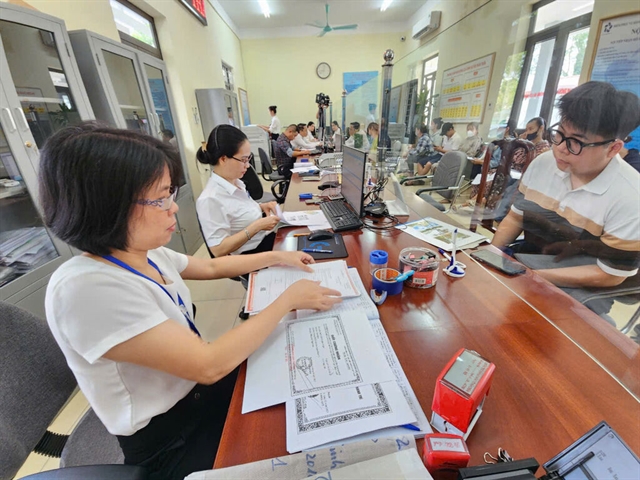
HÀ NỘI — After years of growth driven largely by urban expansion, infrastructure investment and capital inflows, Hà Nội is shifting toward a knowledge- and innovation-based development model, with digital transformation at the heart of its long-term growth strategy.
Over the past year, the capital has accelerated efforts to move beyond simply applying digital technologies to embrace data-driven governance, laying the groundwork for faster, more sustainable economic development.
According to Nguyễn Văn Phong, deputy secretary of the Hà Nội Communist Party Committee, the city is implementing Resolution 57, issued by the Communist Party of Việt Nam in December 2024, on breakthroughs in science, technology, innovation and national digital transformation, to modernise both technology and the city's governance.
The transition has gained momentum following the introduction of the two-tier local government model on July 1 last year.
Rather than merely streamlining administrative structures, Hà Nội is restructuring workflows, developing shared data systems and redesigning public services to better serve citizens and businesses.
“Data and digital transformation lie at the heart of the new governance model,” Phong said. “The ultimate goal is to ensure that management decisions are based on data, implementation is transparent and performance can be measured through clear outcomes.”
A key initiative is the HanoiWork digital workplace platform, which enables authorities to monitor tasks across all levels of government in real time, assign responsibilities to individual agencies and officials and evaluate performance using key performance indicators and objectives and key results. The system also automatically flags delayed assignments.
The platform has been deployed across 179 agencies, involving more than 77,000 officials and managing nearly 240,000 tasks, marking a shift from report-based administration to data-driven governance.
Digital skills
Alongside digital governance, the city has identified digital skills as a critical factor in successful transformation.
Cù Ngọc Trang, director of the Hà Nội Department of Science and Technology, said the city had introduced a digital competency framework for public officials and residents and approved a digital skills development programme through 2030.
Over the past year, tens of thousands of officials have received training in digital transformation, cybersecurity and AI, while more than 5,400 community digital technology teams continue to support digital adoption at the local level, according to Trang.
Hà Nội aims to ensure that every public official possesses essential digital skills, with plans to introduce AI assistants within this year to help civil servants search legal documents, prepare reports, review records, analyse data and support policy formulation.
The city has also accelerated administrative reform under the principle of "standardise before digitise". Instead of simply transferring existing procedures online, authorities have redesigned service processes from application to supervision.
More than 700,000 administrative dossiers have been processed regardless of applicants' place of residence, over 2,000 administrative procedures have been restructured and the rate of data reuse has exceeded 97 per cent.
Meanwhile, the iHanoi application has become the city's official digital interaction platform, attracting more than 6.2 million user accounts and hundreds of millions of visits. These developments have improved transparency, accountability and the quality of public services.

Innovation engine
Beyond public administration, Hà Nội increasingly views data as a strategic resource for innovation and economic growth.
The city has developed shared databases covering multiple sectors, including information on more than 2.1 million land parcels, 93 open datasets and over 9.2 million electronic health records, covering nearly 99 per cent of the population. Data from public hospitals has also been integrated into a unified system.
Rather than focusing solely on technology development, the city is identifying practical challenges in transport, healthcare, education, environmental protection, urban planning and cultural heritage and traditional craft villages.
After the problems are identified, authorities commission universities, research institutes, businesses and start-ups to develop innovative solutions.
To support this approach, the city is establishing an innovation centre designed to connect research, incubation, business acceleration, investment and technology commercialisation.
Under this model, the government will identify priority challenges and commission research projects, while universities and research institutes provide expertise and businesses and start-ups develop practical solutions.
The city is also strengthening its policy framework for innovation through regulatory sandboxes, venture capital initiatives, talent attraction policies and support for technology enterprises.
Hà Nội aims for the digital economy to contribute around 40 per cent of its Gross Regional Domestic Product by 2030. It also plans to expand its network of innovation centres and technology incubators, with Hòa Lạc Hi-Tech Park serving as the city's principal research and development hub.
Initial results suggest digital transformation is beginning to reshape not only public administration, but also Hà Nội's economic growth model.
The city continues to attract large-scale investment projects in semiconductors, electronics and high technology, while collaboration among government agencies, businesses and universities has expanded significantly.
During the first six months of this year alone, Hà Nội signed 23 cooperation agreements on science, technology and innovation and led the country in both industrial property filings and the number of intellectual property titles granted.
Despite this progress, city leaders acknowledge that significant challenges remain. The innovation ecosystem requires further development, the skilled workforce must be expanded and mechanisms for testing and commercialising new technologies need to become more effective.
The next stage of development should focus on making science, technology, innovation and digital transformation the primary drivers of economic restructuring, Phong said.
Hà Nội will continue developing a science and technology workforce linked to Hòa Lạc Hi-Tech Park, universities and research institutes, while implementing a 100-day digital transformation acceleration programme centred on the digital economy and digital society.
As competition among major cities increasingly depends on technological capability and innovation, digital transformation is expected to provide Hà Nội with a new competitive advantage.
By placing data, science, technology and innovation at the centre of its development strategy, Hà Nội aims to build a more resilient, knowledge-based economy while strengthening its position as one of Việt Nam's leading centres for science, technology and innovation. — VNS