Deputy PM receives IMF Asia-Pacific Director
Deputy Prime Minister Nguyễn Văn Thắng received Krishna Srinivasan, Director of the Asia and Pacific Department at the International Monetary Fund (IMF), in Hà Nội on June 8.
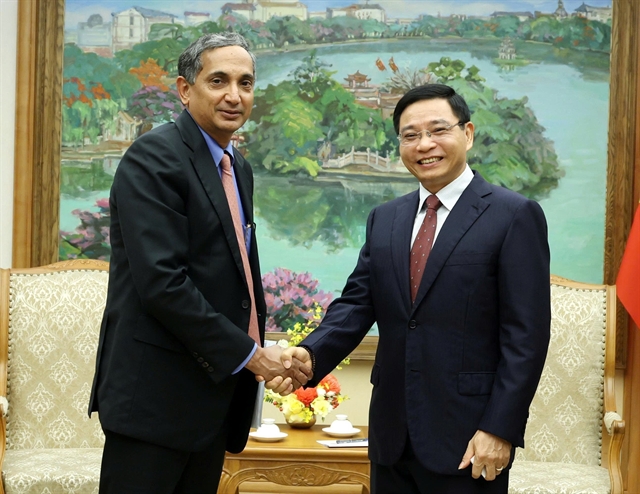
HÀ NỘI — Deputy Prime Minister Nguyễn Văn Thắng received Krishna Srinivasan, Director of the Asia and Pacific Department at the International Monetary Fund (IMF), in Hà Nội on June 8.
At the reception, Thắng said Srinivasan’s visit comes at an important time as Việt Nam has recently completed its strategic framework for a new stage of development. He stressed that Việt Nam always regards the IMF as a reputable advisory partner and a trusted partner whose assessments and recommendations are carefully considered during its policymaking process.
For his part, Srinivasan said the IMF highly values Việt Nam’s recent achievements. Despite external shocks, Việt Nam’s economic outlook in 2026 remains positive compared with many other peers in the region. The IMF also recognised the country’s effective policy responses, particularly in ensuring fuel supplies, thus mitigating the impact of global energy price fluctuations.
The IMF praised Việt Nam’s long-term development orientation, including its goals of maintaining high growth and becoming one of the world’s 30 largest economies by GDP by 2030. It also welcomed the Government’s commitment to preserving macroeconomic stability rather than pursuing short-term growth at any cost.
Regarding Việt Nam’s plan to increase public investment over the medium and long term, he said his fund described the policy as positive, while noting the need to improve the efficiency of resource use, ensure sustainable capital mobilisation and maintain national financial security.
The IMF suggested that Việt Nam continue deepening its capital and debt markets to mobilise resources more effectively for development. It expressed readiness to share its research results and provide technical assistance in financial and capital market development.
Krisha Srinivasan affirmed that the IMF will continue to accompany and support Vietnam in the development of its financial sector, thereby helping to strengthen resilience and promote sustainable growth in the years ahead.
Welcoming the guest's recommendations, Thắng appreciated the IMF’s report and its recommendations on maintaining macroeconomic stability, controlling inflation, exercising prudence in the use of monetary policy space, prioritising fiscal policy space, strengthening the safety of the banking and financial system, and enhancing resilience to external shocks.
The Deputy PM reiterated that Việt Nam remains committed to achieving a growth of 10 per cent or higher in 2026 while controlling inflation and maintaining macroeconomic and financial stability.
However, the country faces challenges from rising inflationary pressure, slowing global growth, growing trade protectionism, geopolitical tensions and tighter international financial conditions, he noted.
To achieve its growth target, Thắng said Việt Nam is accelerating reforms based on three key drivers: institutional reform, strategic infrastructure development and private-sector growth.
The country is also deepening international integration and proactively engaging in shaping regional and international multilateral cooperation mechanisms, demonstrating its role as a responsible partner and making positive contributions to the global economic architecture and governance framework.
He affirmed that the IMF's policy consultation, technical assistance and capacity building programmes have made significant and practical contributions to the formulation and implementation of Vietnam’s macroeconomic policies. He expressed his hope that the fund will continue to maintain regular policy dialogue with the Vietnamese Government and its bodies, particularly the State Bank of Vietnam and the Ministry of Finance. — VNA/VNS