Construction materials under pressure ahead of year-end peak
In the third quarter of 2026, 65 per cent of businesses reported difficulties in their production and business operations due to rising raw material prices, while 24.1 per cent cited supply shortages.
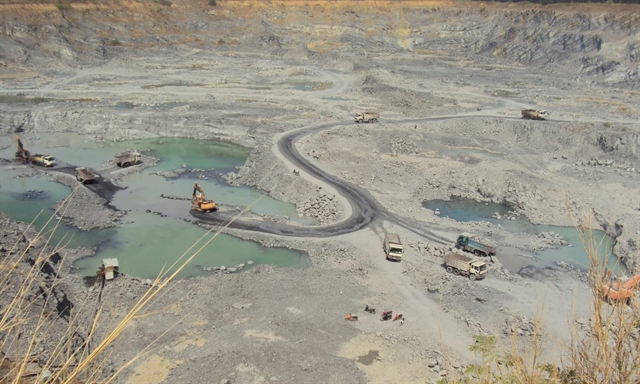
HÀ NỘI — Construction activity is picking up towards the end of the year, while supplies of sand and stone remain constrained in some localities.
Securing material supplies, coordinating resources across regions and keeping published prices in line with market conditions are becoming increasingly important to controlling costs and keeping projects on schedule.
Prices remain uneven
The Thời báo Ngân hàng (Banking Times) online newspaper quoted Nguyễn Duy Nở, director of Hoàng Tuấn Company Limited, as saying that there were discrepancies between prices announced by quarries and actual selling prices for construction stone.
In some cases, the actual selling price reached VNĐ300,000 (US$11.70) per cubic metre, compared with the VNĐ200,000 per cubic metre stipulated in contracts between contractors and project owners. There were even instances where prices had been announced but no materials were available for sale, he said.
The difficulties faced by construction businesses are also reflected in a survey by the National Statistics Office. In the third quarter of 2026, 65 per cent of businesses reported difficulties in their production and business operations due to rising raw material prices, while 24.1 per cent cited supply shortages. Meanwhile, 56.7 per cent said their direct material costs had increased compared with the previous quarter.
Thái Duy Sâm, vice chairman and secretary general of the Vietnam Association for Building Materials, said material prices could remain high in the fourth quarter, although a sharp increase on the scale seen in the early quarters of the year was unlikely.
Rising construction demand is putting pressure on the market, but domestic steel and cement production capacity is generally sufficient to meet demand, he said.
Domestic steel supplies remain abundant. The cement industry, meanwhile, faces an oversupply situation, with total production capacity exceeding domestic consumption, while exports have yet to recover as expected. Nevertheless, selling prices remain dependent on fluctuations in input costs and the business strategies of individual manufacturers.
Several manufacturers continued to adjust their selling prices in October. From October 19, Việt Đức and Hòa Phát raised prices for certain types of steel rebar. In northern Việt Nam, Việt Đức increased rebar prices by up to VNĐ300 per kg, excluding value-added tax, with the increase varying by product. In the cement sector, several companies announced price increases of up to VNĐ50,000 per tonne in late September and early October.
The supply of sand, stone and other fill materials is more directly affected by mining and extraction conditions than that of steel and cement. Quarry reserves, licensing procedures, production capacity and transportation distances all influence the availability of materials in individual localities.
A construction industry expert explained that when demand becomes concentrated in transport infrastructure projects, industrial parks and urban developments, localised shortages can quickly drive up costs, even if overall market prices do not increase significantly.
Even when prices at quarries remain relatively stable, the cost of delivering materials to construction sites can still rise due to fuel prices, transportation distances and supply arrangements. The acceleration of construction schedules across multiple projects can create concentrated demand over a short period, putting pressure on both material availability and transportation capacity.
Securing supplies and keeping prices in check
Supply constraints were also highlighted at a recent meeting on material supply coordination in southern Việt Nam. Demand for construction materials for public investment projects in HCM City is placing significant pressure on the market’s supply capacity, particularly for construction sand and filling sand. Securing sufficient material supplies has therefore become essential to keeping major transport infrastructure projects on schedule in the city and surrounding areas.
According to recent information from the HCMC Traffic Construction Investment Project Management Board (Traffic Board), during the last four months of this year, 20 projects under its management are expected to require approximately 1.9 million cubic metres of construction aggregates, 550,000cu.m of construction sand, 1.9 million cu.m of filling sand and 3.7 million cu.m of embankment soil.
However, current quarry output remains insufficient to meet actual demand. Supply from construction sand quarries covers only around 50 per cent of demand, while filling sand meets approximately 38 per cent. Supply of construction aggregates and embankment soil is generally sufficient, although allocation must still be coordinated to match individual project schedules.
The remaining material requirements for projects managed by the Traffic Board as of the end of last month stood at approximately 1.4 million cu.m of filling sand, 350,000cu.m of construction sand, 900,000cu.m of aggregates and three million cu.m of embankment soil. The remaining shortfall in embankment soil is concentrated mainly in the former Bình Dương area.
This situation highlights that material supply is no longer an issue confined to individual projects or localities, but has become a regional supply chain challenge across southern Việt Nam. As construction accelerates simultaneously across multiple projects, access to quarry resources, extraction capacity and transportation costs directly affect both project timelines and investment costs.
To address these longer-term challenges, the Traffic Board has proposed that the HCMC People's Committee and relevant departments continue expanding special mechanisms to grant extraction permits to mines supplying key construction materials, including manufactured sand, natural sand, soil and construction aggregates.
It has also proposed introducing price controls at quarries licensed under these special mechanisms to ensure that material supplies are prioritised for the city's key infrastructure projects.
In northern Việt Nam, the Vietnam Department of Geology and Minerals has sought feedback from 10 provinces on a draft national material supply coordination plan.
The plan focuses on reviewing existing quarries, their reserves and production capacity, as well as the material requirements of construction projects, to assess the potential for coordinating supplies between provinces.
Participants also discussed ways to address difficulties in obtaining exploration and extraction licences, consider increasing the production capacity of existing quarries that meet the necessary conditions, and explore the possibility of bringing new quarry areas into operation. Implementation must comply with regulations governing geology, minerals, land use and environmental protection.
To help balance supply and demand, the Vietnam Department of Geology and Minerals is continuing to develop a digital mapping platform for construction material supply and demand. Local authorities have been asked to update data on licences, reserves, unit prices and projected demand for the 2026–2030 period.
The coordination plan must clearly identify available production capacity, delivery schedules and transportation arrangements in line with the requirements of individual projects.
Lê Nam Hải, chairman of the Southern Building Materials Group, recommended that construction businesses plan their material purchases, consider placing orders early for materials whose prices are likely to rise and negotiate price adjustment clauses in their contracts.
Regarding price management, the Ministry of Construction asked local authorities to promptly publish material prices at quarries, production facilities, storage yards and construction sites, including transportation costs, to ensure alignment with market conditions.
Where prices fluctuate abnormally, updates and announcements should be made monthly or more frequently when necessary. The ministry also called for inspections and reviews of the factors determining the prices of sand, stone and embankment fill materials in cases where unusually high price increases have been observed. — VNS