Capital-market channels widened after FTSE upgrade: expert
Việt Nam is broadening its capital-market channels as the FTSE upgrade opens access to more global investors while new bond mechanisms seek to mobilise longer-term funding for infrastructure.

HÀ NỘI — Việt Nam is widening its capital-raising options as its stock market enters FTSE Russell’s Secondary Emerging Market category and new rules give HCM City greater authority to develop municipal and project bonds.
The two developments could expand access to both international equity investors and longer-term debt capital, but market depth, liquidity, transparency and risk management will be key to turning the new access into sustained investment, according to EBC Financial Group.
Việt Nam officially entered FTSE Russell’s Secondary Emerging Market category on September 21 after reforms to trading, settlement and foreign-investor access. The reclassification gives Vietnamese equities access to a much larger pool of international capital, but also puts them in direct competition with other emerging markets.
Foreign flows have yet to translate into sustained buying. Reuters data cited by EBC showed foreign investors recorded net purchases of about VNĐ2.7 trillion (US$103 million) in the week before the upgrade, but remained net sellers of about VNĐ91 trillion year-to-date.
FTSE Russell has estimated that the reclassification could redirect as much as $6 billion into Việt Nam in the future. But benchmark-driven passive flows are only part of the picture, as active investors will also assess valuations, earnings, liquidity, currency movements and macroeconomic risks before allocating capital.
“The upgrade gives Việt Nam access to a much larger pool of international capital, but it also places the market in a more demanding competition,” said Sana Ur Rehman, senior market analyst at EBC Financial Group.
He said passive flows would follow the index timetable, while active investors would assess whether Việt Nam could generate sufficiently attractive returns to increase their allocations relative to other emerging markets.
Việt Nam’s relatively attractive valuation could help draw active investors. VinaCapital estimated the market’s 2026 forward price-to-earnings ratio at about 12.7 times, below 14.3 times for Thailand and 14.9 times for Malaysia. It also forecast earnings per share growth of 42.3 per cent in 2026 and 13.4 per cent in 2027.
EBC said a sustained re-rating would depend on earnings growth broadening beyond a small group of large-cap companies. Growth across banks, manufacturing, consumer businesses, technology, logistics and infrastructure could help narrow Việt Nam’s valuation discount against regional peers.
“A low valuation creates an attractive entry point, but it is not enough to drive a sustained re-rating,” Rehman said, adding that active investors would look for durable earnings and cash flow across a broader range of sectors.
Foreign inflows are likely to remain selective in the coming months rather than turn into sustained buying. EBC expects investors to focus on companies with strong earnings prospects, while broader inflows will depend on market liquidity and the global interest-rate and currency environment.
The next major milestone will come in March 2027, when FTSE Russell is scheduled to add a further 20 per cent of the eligible weight, taking the cumulative inclusion factor to 30 per cent.
A wider funding base
While the FTSE upgrade expands access to equity capital, Việt Nam is also developing instruments to meet the longer-term funding needs of infrastructure projects.
The Urban Development Law took effect on October 1, giving the HCM City People’s Council authority to decide on municipal and project bond issuance through the Việt Nam International Financial Centre in HCM City (VIFC-HCMC).
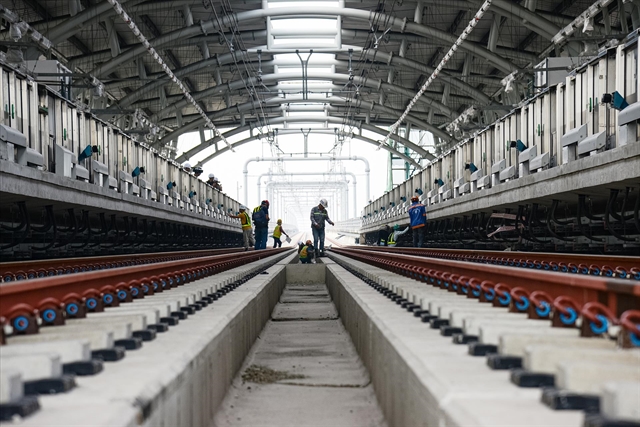
VIFC-HCMC has identified municipal and project bonds as foundational financial products, with potential applications including metro systems, ports, logistics infrastructure and energy projects. The issuance framework was still under consultation in September, and the first actual issuance has not yet been verified.
The rationale is partly about matching the maturity of funding with the life of an asset. Railways, ports, logistics networks and energy projects can take years to build before generating stable cash flows. Long-term bonds could therefore complement bank credit by connecting these projects with institutional investors able to hold assets over longer periods.
“The opportunity here is to create a broader financing system in which banks and capital markets can play complementary roles,” Rehman said.
"Long-term infrastructure benefits from long-term funding, and a deeper bond market can help connect projects with investors that are prepared to hold duration over many years."
But issuing bonds is not the same as building a functioning bond market. EBC identified pricing, liquidity, transparency and investor diversity as key requirements. Investors need sufficient information to assess issuers and projects, while secondary-market liquidity is needed to allow them to adjust their exposure.
International capital could further broaden the funding base, but would introduce additional currency risks.
For equity investors, the relatively high level of US Treasury yields creates an alternative source of returns against which emerging-market assets are assessed. For project bonds, meanwhile, borrowing in a foreign currency while generating most project revenues in đồng can expose issuers to exchange-rate movements.
The developments point to a broader capital-market structure in Việt Nam, with the FTSE upgrade widening access to international investors and municipal and project bonds opening new channels for long-term capital. The key test will be whether these channels can build sufficient liquidity, transparency and investor diversity to support sustained capital flows. — BIZHUB/VNS