Cà Mau prioritises infrastructure investment to achieve strong growth
Cà Mau Province is accelerating major infrastructure projects and improving its investment climate as the southernmost province aims to achieve double-digit economic growth in 2026 and beyond.
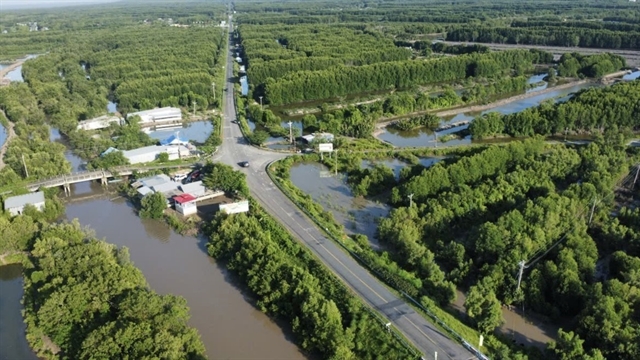
CÀ MAU —From major transport projects to sweeping investment reforms, Cà Mau is accelerating efforts to reshape itself into a key economic and logistics hub in Việt Nam’s southern coastal region, targeting double-digit growth in the years ahead.
Following the administrative merger with Bạc Liêu Province, the enlarged Cà Mau now covers nearly 8,000sq.km and holds a strategic geographical position with three sides facing the sea and several island clusters serving as important maritime gateways.
Provincial authorities say the locality is receiving increasing support from the Government and central ministries through a series of large scale transport and logistics projects designed to strengthen regional connectivity and reinforce national defence and security.
Transport push
Recognising transport infrastructure as a key driver of growth, Cà Mau has prioritised investment in socio-economic infrastructure, particularly transport networks, to ensure better integration among road, sea and air transport systems.
Several regional and national level projects are currently under development, including the Cần Thơ-Cà Mau-Đất Mũi Expressway.
The section running through Cà Mau stretches nearly 103km, featuring four lanes and a designed speed of 100kph.
The province is also speeding up work on the Hòn Khoai General Port project, which is expected to handle up to 20 million tonnes of cargo annually and accommodate vessels of up to 250,000DWT.
Road infrastructure has expanded significantly in both scale and quality.
The province currently has seven national highways with a combined length of 353km and 28 provincial roads stretching nearly 713km.
In addition, the province has almost 1,825km of communal roads and more than 16,333km of rural transport routes.
Authorities have completed site clearance and handed over all land needed for the dual use Hòn Khoai Port project and the more than 17km road connecting the mainland to Hòn Khoai Island.
Other key transport routes include National Highway 1, National Highway 63, Quản Lộ-Phụng Hiệp Route, the Nam Sông Hậu Route, the Southern Coastal Corridor, the Hồ Chí Minh Road section through the province and the bypass route around Cà Mau City.
In the aviation sector, Cà Mau Airport is currently classified as a level 3C civil airport combined with military operations and can accommodate ATR 72 aircraft.
The province is coordinating with Airports Corporation of Vietnam to accelerate an upgrade project that will expand the airport to level 4C standards with a 2,400m runway and annual capacity of one million passengers.
Once completed, the airport will be able to receive Code C aircraft such as the A320 and A321.
Authorities expect the upgraded airport to resume operations by the end of this year.
Dư Minh Hùng, director of the province Department of Construction, said public investment disbursement in the first four months of the year exceeded 20 per cent of the assigned plan, although progress remained below expectations.
The province is targeting completion of several major projects in 2026, including the airport expansion, ring roads connecting expressways and coastal economic centres, the Hòa Bình 2 Bridge, Vàm Xáng Bridge, coastal roads and upgrades to eastern and western sea dykes.
At the same time, Cà Mau is working with central ministries to accelerate implementation of the Cà Mau-Đất Mũi Expressway, transport links connecting Đất Mũi to Hòn Khoai Port, upgrades to National Highway 1 and National Highway 63, the Hồ Chí Minh Road and the Hà Tiên-Rạch Giá-Bạc Liêu Expressway.
The province is also implementing a development scheme for the Hòn Khoai island cluster aimed at strengthening both economic growth and national defence.
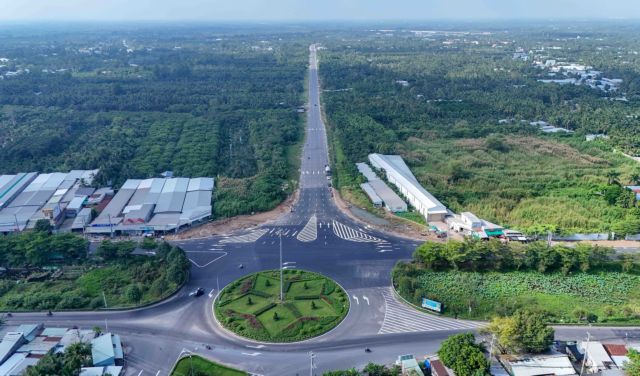
Business climate
Alongside infrastructure development, Cà Mau is intensifying efforts to improve the business environment and attract more domestic and foreign investors.
Huỳnh Công Quân, director of the Cà Mau Department of Finance, said the province had granted 728 new business registration certificates in the first months of this year, up 85.2 per cent year on year, with total registered capital reaching VNĐ3.64 trillion (US$140 million).
The province currently has 10,084 active enterprises with combined registered capital of VNĐ126.4 trillion.
Administrative reform and digital transformation efforts have also improved investment procedures, with 100 per cent of enterprise registration applications now submitted online.
In April alone, Cà Mau attracted three new investment projects worth nearly VNĐ1.85 trillion ($71.3 million).
In the first four months of 2026, the province licensed 16 new projects with total registered capital of VNĐ13.2 trillion ($509 million), four more projects than in the same period last year.
The province currently hosts 709 active investment projects with total registered capital of VNĐ341.8 trillion ($13.2 billion), including 30 foreign direct investment projects worth a combined US$4.85 billion.
Provincial leaders expect improved regional connectivity through road, sea and air transport infrastructure to create stronger momentum for investment attraction in the coming years.
Growth target
At a recent meeting on economic growth targets, Chairman of the provincial People’s Committee Lữ Quang Ngời urged departments and local authorities to focus on achieving double digit growth while continuing to remove obstacles facing businesses and production activities.
To achieve the province’s 10 per cent growth target for 2026, Cà Mau is also proposing special mechanisms and policy support from the central Government to unlock additional development resources. — VNS