AMRO lifts Việt Nam growth forecast to 7.5 per cent amid improving regional outlook
AMRO has raised its forecast for Việt Nam's economic growth to 7.5 per cent this year, joining a growing number of international institutions that have turned more optimistic about the country's outlook.
HÀ NỘI — The ASEAN+3 Macroeconomic Research Office (AMRO) has raised its forecast for Việt Nam's economic growth to 7.5 per cent this year, citing stronger domestic demand, resilient investment and robust AI-driven technology exports across the region.
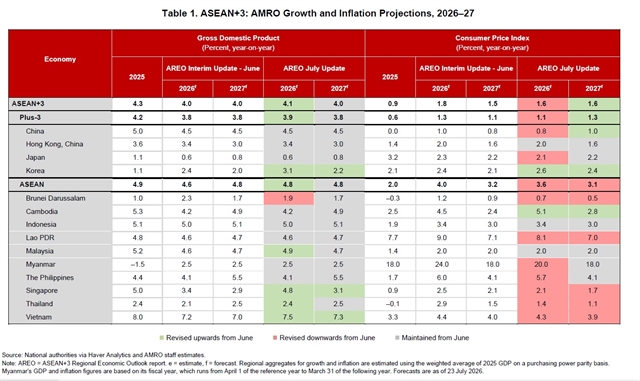
The revised projection, up from 7.2 per cent in AMRO's June update, makes the Singapore-based research organisation the latest international institution to upgrade its outlook for Việt Nam following stronger-than-expected economic performance in the first half of the year.
Việt Nam's GDP grew 8.18 per cent in the first half of 2026, up from 7.63 per cent a year earlier, as growth accelerated from 7.83 per cent in the first quarter to 8.39 per cent in the second quarter.
AMRO also raised its forecast for 2027 growth to 7.3 per cent from 7.0 per cent, while lowering its inflation forecasts to 4.3 per cent for 2026 and 3.9 per cent for 2027.
The latest revision follows a series of more optimistic forecasts by international financial institutions.
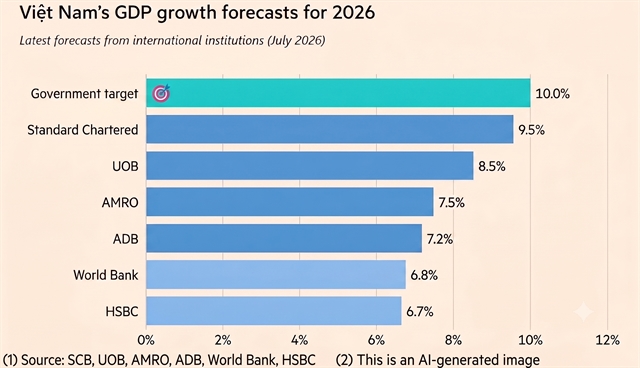
Standard Chartered recently raised its projection for Việt Nam's GDP growth this year to 9.5 per cent, while Singapore-based UOB lifted its forecast to 8.5 per cent, reflecting confidence in the country's strong domestic demand, manufacturing activity and exports.
Although AMRO's forecast remains more conservative than those of Standard Chartered and UOB, it is above the World Bank's latest projection of 6.8 per cent and the Asian Development Bank's forecast of 7.2 per cent, highlighting growing confidence that Việt Nam will remain one of Asia's fastest-growing economies.
AMRO's revised outlook comes as it upgraded its forecast for the ASEAN+3 region – comprising the 10 ASEAN member states plus China, Japan and South Korea – to 4.1 per cent growth in 2026 from 4.0 per cent projected in June.
Regional growth is expected to ease slightly to 4.0 per cent next year, while headline inflation has been revised down to 1.6 per cent, pointing to lower global commodity price assumptions.
According to the report, the regional economy has remained resilient despite geopolitical tensions in the Middle East. Household spending has stayed firm, investment has continued to expand and exports have been supported by strong demand for semiconductors and other AI-related products.
At the same time, disruptions to energy and industrial input supplies have proved less severe than initially feared, allowing manufacturing activity to continue expanding.
"ASEAN+3 has remained resilient, supported by firm domestic demand and its central role in global AI supply chains," said AMRO Chief Economist Dong He.
"The impact of the Middle East conflict has also been less severe than initially expected, although elevated energy and input costs continue to pose risks to inflation and industrial activity."
The report said ASEAN+3 exports grew by nearly 20 per cent in the first quarter, with AI-enabling products accounting for almost two-thirds of the increase. Worldwide semiconductor sales also nearly doubled during the first five months of the year as investment in AI infrastructure accelerated.
Tourism also contributed to growth, with international arrivals across the region increasing 7.5 per cent in the first quarter. Việt Nam was among the strongest-performing destinations.
Despite the improved outlook, AMRO warned that significant uncertainties remain.
The organisation said renewed escalation of the Middle East conflict could drive up energy, shipping and food prices, while weaker-than-expected demand for AI-related products could weigh on exports and investment across the region.
AMRO highlighted the technology cycle as one of the biggest risks facing the regional economy.
Under a scenario in which global technology investment slows to its 2024 pace, ASEAN+3 growth could fall to 3.7 per cent in 2026 and 2.5 per cent in 2027, marking the region's weakest expansion since the Asian Financial Crisis, excluding the pandemic years.
The report also pointed to financial market volatility and rising protectionism as key downside risks.
Uncertainty over future US trade measures, together with possible tighter export controls and broader trade restrictions, could increase costs, disrupt regional supply chains and weigh on economic growth.
"The wide range of plausible outcomes underscores the importance of continued vigilance and sound macroeconomic policies," said He.
"Policymakers will need to respond flexibly to differing domestic conditions and rapidly evolving external risks, particularly the AI cycle and the Middle East conflict." — VNS