Agriculture sector faces export push to hit $74 billion target
Exports reached $49.3 billion in the first eight months of the year, up 7 per cent from a year earlier, leaving the sector with about $24.9 billion to achieve in the remaining four months, or an average of $6.23 billion a month.
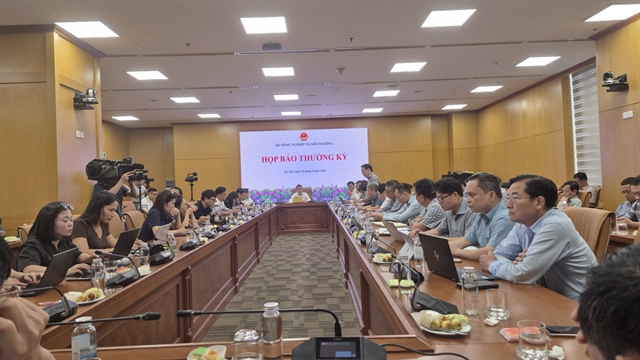
HÀ NỘI — The agriculture, forestry and fisheries sector will need to sharply accelerate exports in the final four months of 2026 to meet its annual target of US$74 billion, the Ministry of Agriculture and Environment said on Wednesday.
Exports reached $49.3 billion in the first eight months of the year, up 7 per cent from a year earlier, leaving the sector with about $24.9 billion to achieve in the remaining four months, or an average of $6.23 billion a month.
Trần Gia Long, deputy general director of the ministry's Department of Planning and Finance, said the results so far provided a foundation for meeting the sector's targets, but the remaining workload was substantial.
The sector needs to accelerate production and exports while responding to factors that could affect output and overseas shipments, he said at the ministry's regular news conference.
Agricultural products accounted for $25.66 billion of exports in the first eight months, while forestry products generated $12.57 billion, fisheries $7.94 billion and livestock products $511.9 million.
Imports of agricultural, forestry and fisheries products reached $35.06 billion in the period, up 8.1 per cent, resulting in a sector trade surplus of $14.25 billion.
The ministry is maintaining a full-year growth target of 4 per cent for the agriculture, forestry and fisheries sector. Under its current scenario, growth needs to reach about 4.15 per cent in the third quarter, 4.05 per cent in the first nine months and about 4.2 per cent in the fourth quarter.
Agriculture is targeted to grow by about 3.77 per cent for the year, forestry 5.23 per cent and fisheries 5.12 per cent. Crop production is expected to increase by about 2.93 per cent, while livestock production is targeted to rise 5.02 per cent.
Meeting the export target could become more difficult in the final months of the year due to extreme weather, natural disasters, fluctuations in international markets and tighter requirements in importing countries.
The ministry said the focus would therefore be not only on increasing export value but also on securing supplies, maintaining stable production and increasing the value of individual product groups.
Market monitoring and traceability
The ministry plans to closely monitor production and market developments by sector and product, updating data on output, value and factors affecting supply and demand to adjust production plans when necessary.
For exports, the ministry will closely monitor individual markets and product groups, work to remove technical barriers, accelerate the issuance of planting-area and packing-facility codes, and strengthen traceability. These measures are key to helping Vietnamese agricultural products retain existing markets and gain access to new ones.
For seafood, it will continue measures to address the EU's yellow card warning over illegal, unreported and unregulated fishing, with greater transparency, accountability and traceability across the supply chain.
The domestic market will also be used to diversify sales channels and reduce reliance on a limited number of export markets, the ministry said.
Weather remains another risk. Storms, tropical depressions, heavy rainfall and landslides, particularly in northern mountainous and central areas, could disrupt production and the supply of raw materials for processing and export.
The ministry said disaster preparedness would need to be implemented early to protect production already achieved and ensure sufficient raw materials for the remainder of the year.
It also aims to disburse all allocated public investment funds and prepare for the implementation of the National Target Programme for 2026-35 from January 1, 2027.
In the resources and environment sector, the ministry will focus on resolving bottlenecks involving land, minerals, water resources and environmental issues that affect investment, production and business activity. It will also accelerate the development of land databases and address pollution concerns.
Besides, it will continue to promote science and technology, innovation and digital transformation, while improving databases and implementing Politburo directives, including a '100-Day' campaign to address bottlenecks in to carry out Resolution No 57-NQ/TW. —VNS