Agricultural, forestry and fishery exports reach nearly $49.3 billion after eight months
Asia remained Việt Nam’s largest export market, accounting for 45.5 per cent of total market share, with exports to the region increasing 11.3 per cent year on year.
HÀ NỘI — Việt Nam’s agricultural, forestry and fishery exports totaled nearly US$49.3 billion in the first eight months of this year, up 7 per cent year on year, maintaining growth momentum despite divergent trends among major product groups.
Fruit and vegetables, seafood, pepper and several other commodities posted positive results, while coffee, rice, rubber and tea came under pressure. Abundant domestic supply and favourable market conditions are also expected to support durian exports in the final months of the year.
According to figures recently released by the Ministry of Agriculture and Environment, exports of agricultural, forestry and fishery products reached an estimated $6.5 billion in August, down 3.5 per cent from the previous month but up 3.6 per cent year on year.
Of the eight-month total, agricultural product exports reached $25.7 billion, up 2.7 per cent; seafood exports $7.9 billion, up 10.9 per cent; forestry products $12.6 billion, up 5.4 per cent; and livestock products $511.9 million, up 30 per cent. Exports of production inputs surged 64.8 per cent to $2.6 billion.
Asia remained Việt Nam’s largest export market, accounting for 45.5 per cent of total market share, with exports to the region increasing 11.3 per cent year on year. The Americas accounted for 21.5 per cent, Europe 13.4 per cent and Oceania 1.5 per cent, while exports to Africa fell 18.3 per cent.
China, the US and Japan were the three largest individual markets, accounting for 22.7 per cent, 19.1 per cent and 6.8 per cent of total market share, respectively. Exports to China rose 22.1 per cent, while those to Japan increased by 2 per cent. Exports to the US edged down 0.4 per cent.
Fruit and vegetables, seafood remain bright spots
Fruit and vegetables remained one of the strongest-performing groups. Exports were estimated at $1.2 billion last month, bringing the eight-month total to over $6 billion, up 24.9 per cent year on year.
China remained the largest market, accounting for 58.9 per cent of fruit and vegetable exports, followed by the US with 7.6 per cent and South Korea with 4.2 per cent.
Seafood exports also maintained strong growth, reaching $7.9 billion in the first eight months, up 10.9 per cent. August exports were estimated at approximately $1.1 billion. China was the largest market with a 24 per cent share, followed by the US and Japan.
Pepper exports also performed positively. Việt Nam exported 190,100 tonnes worth $1.2 billion in the first eight months, up 14.5 per cent in volume and 9.6 per cent in value. The average export price reached $6,513.80 per tonne.
Meanwhile, coffee, rice and tea recorded declines in export value. Coffee exports reached 1.3 million tonnes worth approximately $6 billion. Although volume increased 13.1 per cent, export value fell 9.1 per cent.
Rice exports totalled approximately six million tonnes worth $2.9 billion, down 6.3 per cent in volume and 11.9 per cent in value. The average export price fell 6 per cent to $480.90 per tonne.
Cashew nuts, however, recorded higher export value despite lower volume. Exports fell 1.7 per cent to 474,000 tonnes, while value increased 2 per cent to $3.4 billion, supported by a 3.7 per cent rise in the average export price to $7,058 per tonne.
Durian offers further growth potential
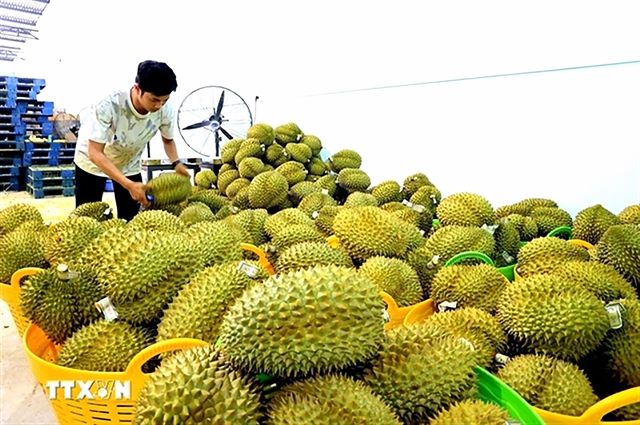
Durian remains a key driver of Việt Nam’s fruit and vegetable exports. According to the Ministry of Industry and Trade, durian exports reached approximately $1.77 billion in the first seven months of the year, up 47.1 per cent year on year. China accounted for more than 93 per cent of total durian export value.
The final months of the year are expected to offer favourable conditions for Vietnamese durian exports as domestic supply enters its peak season, particularly in the Central Highlands. Đắk Lắk and Lâm Đồng are entering the main harvest period, with September and October expected to provide abundant supplies for export.
The end of Thailand’s summer durian crop is also expected to create additional opportunities for Vietnamese products in international markets.
The Ministry of Industry and Trade forecasts that fruit and vegetable exports will maintain growth momentum during the final four months of this year, with durian alone potentially contributing an additional $1.5 billion in export value.
Domestic production has also expanded rapidly. Việt Nam had approximately 195,000 hectares of durian plantations by the end of last year, nearly three times the area recorded in 2020. Production rose from around 600,000 tonnes to 1.8 million tonnes over the same period and is expected to exceed two million tonnes this year.
With expanding supply, strong demand from China and favourable harvest timing, durian is expected to remain an important contributor to the growth of Việt Nam’s fruit and vegetable exports and overall agricultural, forestry and fishery export turnover this year. — VNS